
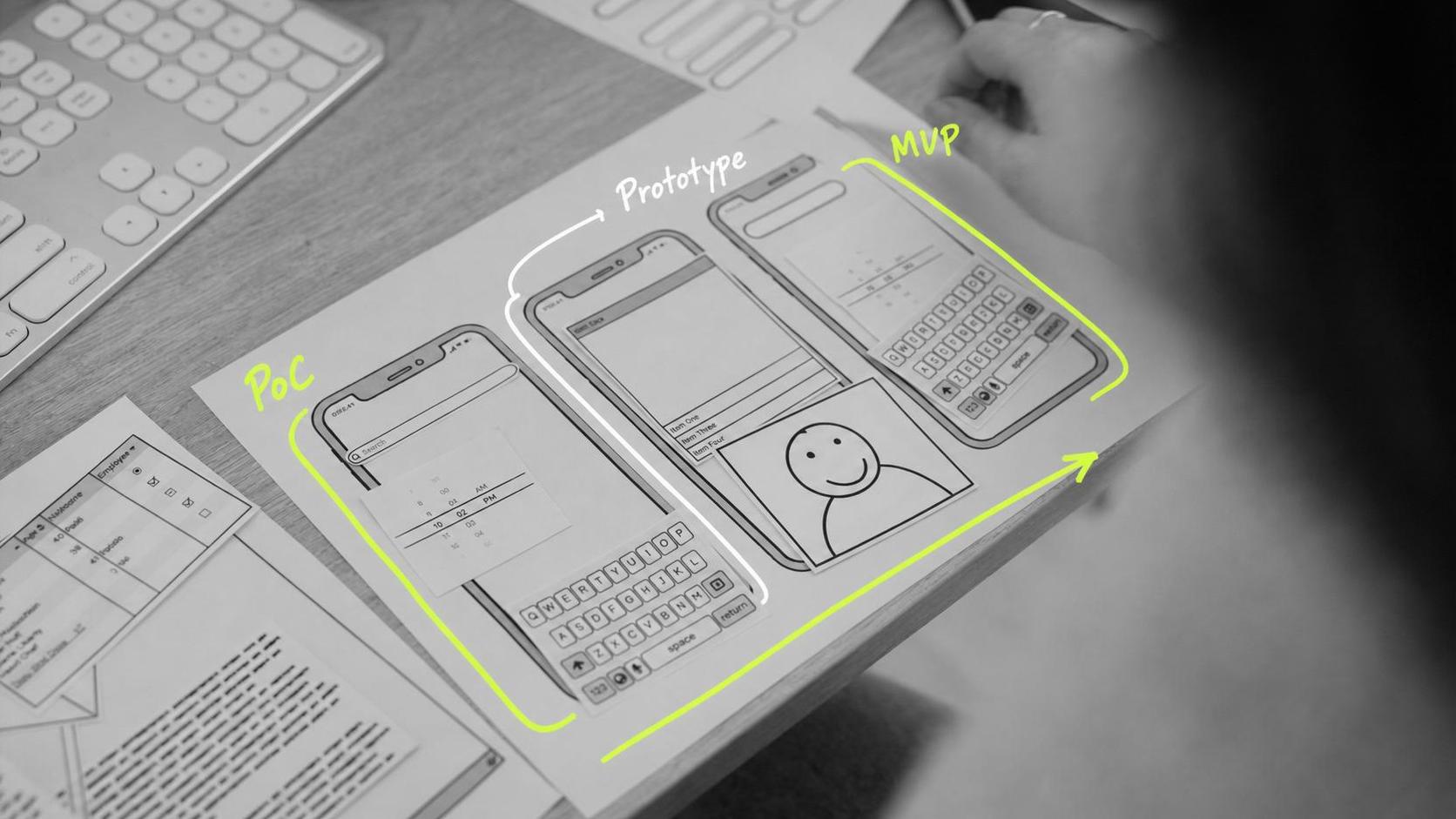
A proof of concept (PoC) tests technical feasibility, a prototype tests design assumptions, and an MVP tests whether real users will adopt and pay for the product. Whether you're comparing PoC vs MVP vs prototype, MVP vs prototype vs PoC, or PoC vs prototype vs MVP for startups — the comparison comes down to which question each tool answers and what that question costs to answer. For first-time founders deciding what to build first, PoC vs MVP for your specific situation depends entirely on whether there's a technical unknown at the center of your product. A PoC takes days, a prototype takes 1–2 weeks, and an MVP costs $20,000–$80,000 and 6–16 weeks. Most founders commission the most expensive tool first — an MVP before the simpler questions are answered. Launch MVP Fast is a fixed-price MVP development company for non-technical founders; choosing the right tool in sequence protects the budget before any code is written.
| Proof of Concept | Prototype | MVP | |
|---|---|---|---|
| Purpose | Prove technical feasibility | Validate design and flow | Test market demand with real users |
| What you build | A focused technical spike | A clickable UI mockup | A working product |
| Who sees it | Internal team | Stakeholders, investors, test users | Real end users |
| Timeline | Days to 2 weeks | 1–2 weeks | 6–16 weeks |
| Cost signal | Near zero (developer time) | $3K–$15K with a designer | $20K–$80K with a dev team |
| Done when | The technical question is answered | Design assumptions are tested | Real users give real feedback |
- What is a proof of concept?
- What is a prototype?
- What is an MVP?
- PoC vs. prototype vs. MVP: how to use all three in sequence
- The mistake founders make before they're ready
- How to decide which one you need right now
What is a proof of concept?
A proof of concept is a focused technical experiment. The goal is narrow: can the core technical approach work? "Will users like this?" is a question for a different tool. A PoC asks only whether the technology underpinning your product can do what you need it to do.
It's not a product. There's no UI, no user accounts, no deployment. A developer (or a small technical team) writes a targeted spike of code to confirm that the key technical component works as expected. The output is an answer, not an artifact. Once you have the answer, the PoC code is typically thrown away.
When a PoC makes sense:
Use a PoC when your product depends on something technically unproven. The three most common situations for early-stage startups:
- Your product uses a specific AI model or LLM to produce output that must meet a reliability or accuracy threshold, and you haven't confirmed the model can do it consistently at the scale and variance you need
- Your product integrates with a third-party API that has unusual rate limits, undocumented behavior, or restrictive data access that could make the core feature impossible
- You're building on specialized hardware or real-time data processing (sensors, Bluetooth integrations, embedded systems, latency-sensitive streams) where the technical risk is structural
The key test: is there a technical unknown at the center of the product that could invalidate the entire direction if the answer is no? If yes, that's a PoC question. If the unknowns are commercial ("will people pay for this?"), a PoC won't answer them.
What a PoC looks like in practice:
A founder is building an app that generates plain-English summaries of lease agreements for tenants who don't understand legal language. Before building any product, a developer feeds thirty sample leases into an LLM and checks whether the output is accurate, consistent, and legally safe to show users. That experiment takes a week. If the model output is unreliable, the founder knows before spending anything on a build. If it works, they proceed with confidence.
Timeline: days to two weeks. Cost: a few days of developer time, often internal. There's nothing to demo to an investor or a user. The deliverable is a confirmed answer.

What is a prototype?
A prototype shows how the product will look and feel, with no working code underneath. It's a design artifact, not a functional product. Users can't create real accounts, data isn't stored, and nothing runs on a server. The output is a set of screens in Figma, linked so that tapping a button advances to the next screen.
High-fidelity prototypes look convincing. They use real typography, real spacing, real color. They can feel nearly identical to the finished product. But the moment you try to complete a real action (submit a form, process a payment, receive a notification), the illusion ends. That's the point: a prototype isn't trying to work, it's trying to communicate.
When a prototype makes sense:
Use a prototype when the remaining unknown is whether the product's flow, navigation, and layout make sense to real people.
- You're briefing a development team and want to give them a precise visual target: a prototype reduces ambiguity and mid-build surprises more than a written spec alone
- You're pitching investors and want to show them the product before it exists: a clickable mockup makes the pitch more concrete than slides
- You want to run user testing before the build starts: showing a prototype to five potential users and watching where they get confused costs a fraction of discovering those problems mid-build
What a prototype costs:
A professional designer building a high-fidelity clickable prototype charges $3,000–$15,000 for one to two weeks of work, depending on the number of screens and flow complexity. For an idea that would otherwise cost $40,000–$80,000 to build, that's a small investment in de-risking the design assumptions.
One critical distinction: a prototype cannot be promoted to a real product. The prototype gets replaced by real engineering, though the design files feed directly into the build. Founders who try to ship a Figma prototype as a product will find it collapses under any real usage.

What is an MVP?
A minimum viable product is the smallest functioning product you can put in front of real users to test whether the market wants what you're building. The build-measure-learn cycle from Eric Ries' Lean Startup applies here: you ship the minimum that works, measure real usage, and iterate toward product-market fit. An MVP runs on a server, users create accounts, data persists, and the core user action works end-to-end. It's software that holds up under real conditions.
The "minimum" part refers to scope only. An MVP contains only the features required to test the core value proposition: the one action a user needs to take to get value. The quality bar is the same as a finished product; what's constrained is how many things the product does.
When an MVP makes sense:
Build an MVP when you've already answered the technical question (or there isn't one worth testing), and you've built conviction through research or prototype testing to justify the cost. The remaining question: will real users adopt this, and will they pay for it?
What an MVP costs and why the cost matters:
A professionally built custom MVP costs $20,000–$80,000 depending on scope and integrations (see how the top MVP development companies compare on pricing and delivery model). The median build takes 6–16 weeks. That investment is significant, which is exactly why the order of operations matters.
According to CB Insights' analysis of startup post-mortems, 42% of startups fail because there was no market need for the product. The MVP is the tool that tests for market need before you make a larger bet. Research from the Presta MVP Roadmap Guide estimates that founders who skip the validation stage waste an average of 6–9 months and $50,000–$150,000 building features no one wanted.
PoC vs. prototype vs. MVP: how to use all three in sequence
The three tools address different unknowns, in order of increasing cost:
- PoC — resolves technical unknowns. Can the core approach work at all? Costs days to two weeks.
- Prototype — resolves design unknowns. Does the flow make sense to the people who'll use it? Costs one to two weeks.
- MVP — resolves market unknowns. Will real users adopt this and pay for it? Costs 6–16 weeks.
Most products don't need all three. A standard SaaS product built on a conventional tech stack (authentication, a database, common third-party integrations) has no meaningful technical unknowns. Skip the PoC and go directly to a prototype, then an MVP.
A product that depends on unproven technology should run the PoC before investing in design or engineering. A product entering a new interaction model where users haven't established habits benefits significantly from prototype testing before the build. Almost every product should launch as an MVP rather than a full-featured product.
The trap to avoid: treating the three as redundant and skipping the prototype stage to save money. Prototypes cost between $3,000 and $15,000. Discovering design problems mid-build tends to double the cost, because you're unbuilding and rebuilding, not just designing. A $7,000 prototype that gets tested with ten potential users and surfaces two navigational problems has saved more than it cost.
The sequence is about spending money on problems in the order that's cheapest to fix: technical first, design second, market third. The difference between MVP and prototype in software development is the same as the difference between a design artifact and a working product — a distinction that matters when a founder is deciding whether to spend $7,000 on Figma screens or $50,000 on engineering. The difference between PoC and MVP is about which question is still open: technical feasibility or market demand. For non-technical founders evaluating proof of concept vs prototype vs MVP, the decision rule is: solve the cheaper unknowns first, in the order they arise.

The mistake founders make before they're ready
The most common expensive error in early-stage product development: commissioning an MVP when a PoC or prototype should have come first.
A founder has a strong idea. They've done market research, talked to potential users, and feel ready. They go to a development agency, say "I want to build an MVP," and the agency quotes $45,000 and ten weeks. Work begins.
Six weeks in, one of two things happens:
The core technical component turns out to have a fundamental limitation: the AI model isn't reliable enough at the required threshold, the API doesn't expose the data needed, the real-time feature can't hit the latency target. A focused two-week PoC at the start would have caught it. Instead, six weeks of work gets scrapped or rebuilt from scratch.
The other version: the team has to change direction mid-build because the design assumptions went untested before the first line of code. Users can't find the navigation, the core action is buried two screens deep, and the intended primary feature turns out to be secondary. A prototype and ten user interviews before the build would have caught it. Mid-build, the fix costs far more.
The tell-tale sign you should run a PoC first:
There's a technical unknown at the center of your product (a specific model, API, or hardware component) and you can't confirm from documentation alone that it does what you need. Spend a week on the PoC before committing the build budget.
The tell-tale sign you should build a prototype first:
You've never shown the product flow to a real potential user. You know what you want to build, and you're confident it's right, but you haven't tested whether the design makes sense to someone who hasn't been living inside the idea. Spend $5,000–$10,000 on a professional Figma prototype and run five to ten user sessions before committing to the engineering build.
Both feel like delays when you're ready to move. They're insurance, and the premium is a fraction of what skipping costs.
How to decide which one you need right now
When to use a PoC vs MVP — and when a prototype fits in between — comes down to three questions. This decision framework applies to any startup founder, but especially to first-time founders who haven't been through this sequence before:
1. Is there a core technical unknown?
Does your product depend on a specific AI model, API, hardware component, or technical approach that you haven't confirmed works the way you need it to? If yes, start with a PoC. Run the experiment, get the answer, then proceed. If no, skip it and move to question two.
2. Have you tested your design assumptions with real people?
Not described the product to them; shown them screens and watched them navigate. If not, build a prototype before the engineering starts. The goal is to surface wrong assumptions before the build makes them expensive to fix.
3. Is the remaining question about market demand?
You know the technology works. You've tested the flow with real potential users and refined the design. The remaining question: will people use this, and will they pay for it? Build an MVP to find out.
You should reach the MVP stage with the technical risk resolved and the design direction grounded in real user feedback. If your MVP launch is the first time real users have seen the product flow, you've skipped at least one important step.
If you're at question three and ready to build, Launch MVP Fast offers instant estimates for non-technical founders: describe your idea and get a real scope and price range in a few minutes, no discovery call required. If you're still at question two or working out scope, the MVP meaning guide covers what belongs inside an MVP and what to cut. Or see the MVP development services page for how the build process works from scoping through handoff.

Questions, answered.
A PoC answers a single yes/no technical question — "can this be built at all?" — using the minimum work required to get the answer. An MVP is a working product you ship to real users to answer a different question: "will people actually use this and pay for it?" A PoC is internal and disposable. An MVP is external and the starting point for your actual product. A PoC might take a week and cost close to nothing; an MVP typically costs $20,000–$80,000 and takes 6–16 weeks.
Only if your product depends on something technically unproven. A standard SaaS product — user accounts, a database, common integrations — has no technical unknowns worth running a PoC on. If your product depends on a specific AI model producing reliable output, or a novel hardware component, or an untested third-party API, run the PoC first. It costs a week and can save you from building twelve weeks of product around something that doesn't work.
A PoC typically takes anywhere from a day to two weeks, depending on what you're testing. You're not building a product — you're running a focused technical experiment. A developer writes the spike, confirms whether the approach works, and documents the result. There's no UI, no user accounts, no deployment. The output is an answer, not an artifact.
Rough ranges: a PoC costs close to nothing in external spend — it's a few days of developer time, often done internally. A prototype with a professional designer runs $3,000–$15,000 for one to two weeks of design work. An MVP built by a professional development agency typically costs $20,000–$80,000 depending on scope, integrations, and team. The biggest mistake is spending MVP-level money before you've answered PoC-level questions.
No — and treating them as the same thing is one of the most common early-stage mistakes. A prototype is a design artifact: it looks and feels like the product, but nothing works underneath. An MVP is a functioning product running on a real server. The design files from a prototype inform the MVP build, but the prototype itself gets replaced by real engineering. You can't promote a prototype to an MVP without rebuilding it from scratch.
When two things are true: you already know the core technology is viable (it's a standard stack with no novel components), and you've already tested the design assumptions with real people — through interviews, prototype testing, or a waitlist that gave you real feedback. In that case, the remaining question is market demand, and an MVP is the right tool. Going straight to an MVP without either validation is what turns a $50,000 build into a $50,000 lesson.